Olivia Neumann · 2 September 2026
Interlinked European Resource Pressures: Examining French Nuclear Trade Issues Alongside Greek Construction Growth and Spanish Distribution Pressures
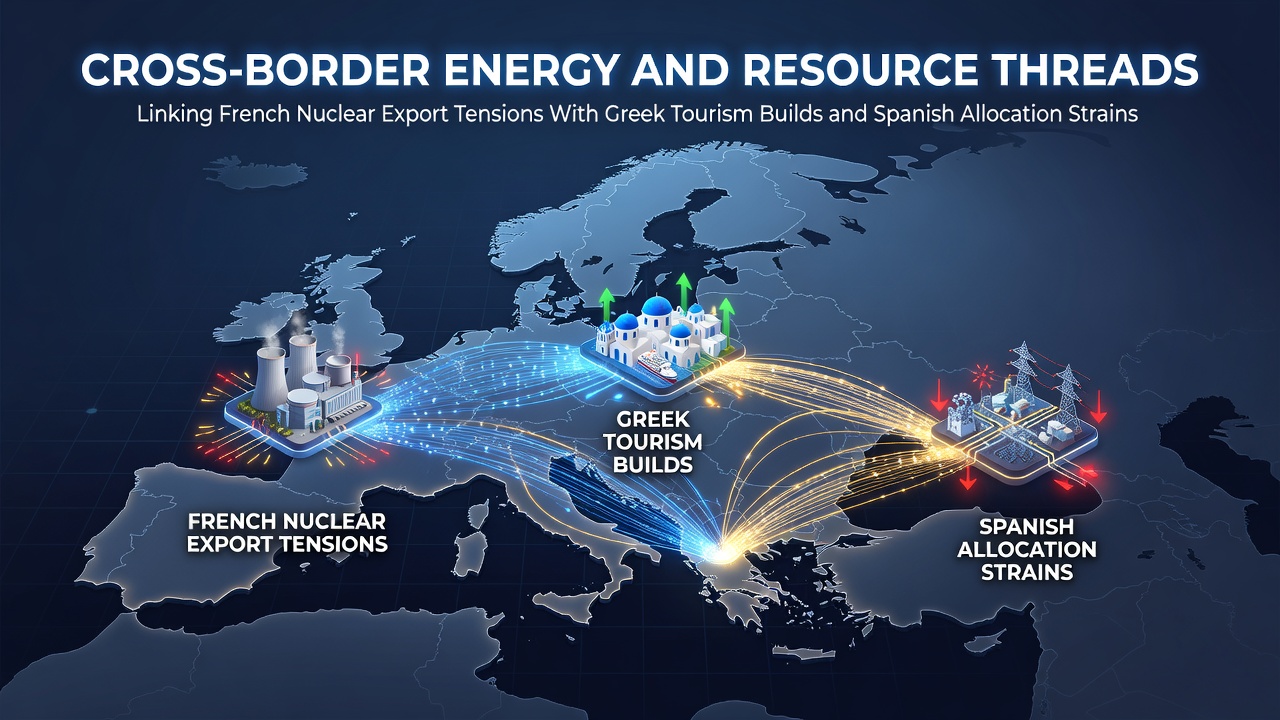
European countries continue to navigate complex overlaps between energy production, export policies, and infrastructure demands that cross national borders. French nuclear facilities maintain significant export volumes to neighboring states while domestic debates over reactor maintenance schedules and regulatory approvals create ongoing friction points in supply agreements. At the same time Greek coastal regions see accelerated permitting for large-scale hotel and resort projects that require reliable power connections and water infrastructure upgrades. Spanish authorities meanwhile manage allocation frameworks for electricity and water across agricultural, industrial, and urban sectors where seasonal peaks often strain existing distribution networks.
France operates one of the largest nuclear fleets in the European Union with export contracts that extend into Italy, Belgium, and occasionally further south during high-demand periods. Regulatory reviews scheduled for late 2025 and extending into September 2026 have prompted several trading partners to seek alternative supply assurances while French operators complete safety assessments on aging units. Data from the European Commission indicates that nuclear-sourced electricity accounted for roughly 65 percent of French generation in 2025 with cross-border flows totaling 65 terawatt-hours annually in recent years. Those volumes directly influence pricing mechanisms in interconnected markets and create ripple effects when maintenance outages occur.
Transmission Networks and Export Agreements
High-voltage interconnectors between France and Spain operate near capacity during summer months when Spanish cooling demand rises sharply while Greek tourism infrastructure expansions add new loads on the eastern Mediterranean grid. Observers note that coordination meetings among transmission system operators have increased in frequency as project timelines for new Greek resorts coincide with French export contract renegotiations. Researchers at the Florence School of Regulation have documented how congestion management protocols on these lines affect both day-ahead and intraday markets across the three countries.
Spanish allocation mechanisms rely on a combination of hydro reservoirs, combined-cycle gas plants, and growing renewable capacity to balance regional disparities between the industrial north and the drier southern provinces. Allocation strains become visible when reservoir levels drop below historical averages and tourism-related construction in coastal zones competes for the same water resources used in power generation. Government statistics released in early 2026 showed that several river basins in southern Spain recorded allocation reductions of 15 to 20 percent compared with the previous decade during peak tourist seasons.
Greek Tourism Expansion and Energy Demand
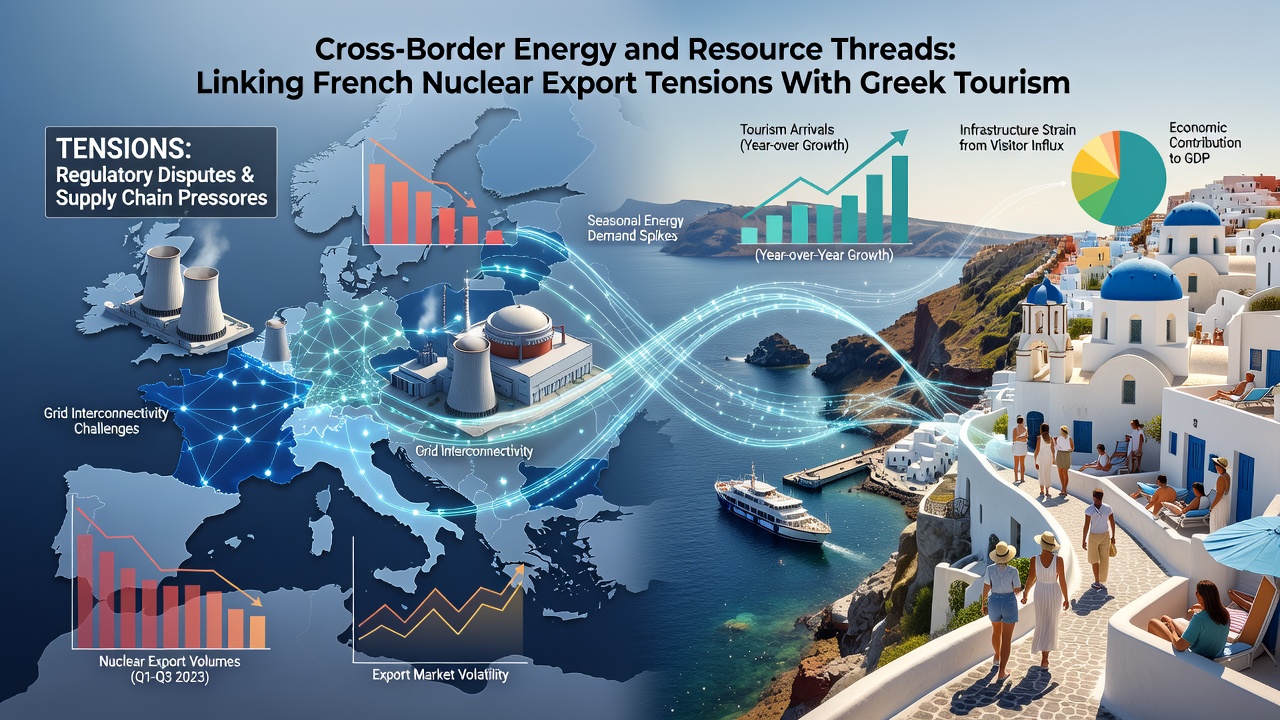
Greek tourism builds have accelerated since 2023 with new hotel complexes and marina facilities concentrated along the Aegean and Ionian coasts. These developments require substantial upfront commitments for grid reinforcement and desalination capacity because many sites sit outside existing high-capacity transmission corridors. Local planning authorities report that average project approval times have shortened while environmental impact assessments now incorporate cross-border energy scenarios that include potential French nuclear supply variability. Tourism revenue figures compiled by the Bank of Greece reached 21.6 billion euros in 2025 and projections for 2026 anticipate continued growth provided infrastructure keeps pace.
Coordination between Greek distribution operators and French exporters occurs through established market coupling arrangements that allow price signals to influence dispatch decisions across multiple borders. When French maintenance schedules shift, spot prices in Greece can rise quickly unless Spanish pumped-storage facilities or Italian imports compensate. Studies published by the Joint Research Centre of the European Commission have modeled several scenarios where simultaneous Greek summer peaks and Spanish drought conditions reduce the buffer normally provided by cross-border flows.
Allocation Frameworks in Spain
Spanish water and electricity allocation rules operate under a basin-level governance structure that assigns priority rights during scarcity events. Agricultural users hold senior rights in many southern basins yet tourism infrastructure projects often receive separate allocations tied to municipal supply contracts. This dual-track system creates periodic tension when both sectors experience simultaneous growth. In September 2026 the Ministry for the Ecological Transition published updated drought contingency plans that explicitly reference energy export dependencies on neighboring states as a factor in national resilience calculations.
Industry reports from the International Energy Agency note that Spain has expanded its liquefied natural gas import terminals and battery storage projects in response to allocation uncertainties. These investments aim to reduce reliance on hydro resources that also support irrigation and tourism water needs. Cross-border electricity trade statistics show Spain remained a net importer from France in most months of 2025 although reverse flows occurred during high wind-generation periods in the north of the country.
Conclusion
Resource threads connecting French nuclear exports, Greek tourism infrastructure, and Spanish allocation decisions illustrate how policy choices in one sector and country quickly propagate through interconnected grids and supply chains. Continued data collection by transmission operators and regulatory bodies will determine whether existing coordination mechanisms scale with projected demand increases through 2027. Updated modeling from multiple European research institutions continues to track these interdependencies as new projects move from planning into construction phases across the region.